
11 July 2018
SAFMA Exco meets
Just after the Executive Committee meeting of South Asian Free Media Association (SAFMA) Sri Lanka Chapter held on July 10, 2018 at SLPI Board Room. In picture:- Lakshman Gunasekara, Thaha Muzammil, Sharmini Boyle, NM Ameen, Hana Ibrahim, Shan Wijetunga and Dilrukshi Handunnetty. Pix by S.L. Azeez


05 July 2018
SAFMA-SL condemns targeting of Lankan journalists
The Sri Lanka chapter of the South Asian Free Media
Association is very concerned about the targeting by politicians of two Sri
Lankan journalists involved in internationally reporting on Sri Lankan issues
published recently in the New York Times newspaper of the USA. We are concerned
that, due to this individual targeting, the professional sights of these
journalists have been violated. We are also concerned that the targeting is
being done by senior leaders of a political group that, when it was last in governmental
power, presided over a regime that saw the collective intimidation and
repression of the news media industry of by extreme violence.
Singling out and publicly targeting individual professionals
for the work they perform for an employer, in this case, an internationally
published newspaper, is only valid if those individuals at least appeared to
have seriously violated the country’s laws in any manner. In the case of the
detailed news report published by the ‘New
York Times’ newspaper of the USA, headlined ‘How China got Sri Lanka to cough
up a port’ on June 25, 2018, the two Sri Lankan journalists concerned
were the local support reporters for the American journalist team belonging to
the ‘New York Times’.
As an organisation of socially concerned journalists,
SAFMA-SL upholds the right of anyone to respond to any news publication in
terms of public criticism of the published item or even its publisher. In terms
of the law as well as professional practice, both locally and internationally,
the responsibility for publication of any news product is held by the publisher
and not the employee professionals concerned.
Individual professionals are singly targeted for
investigation only if there is a violation of law by the publisher that is
formally considered by the authorities as serious enough to investigate and
prosecute all the personnel seen as complicit. In the case of the said news
report, so far, no legal authorities, either Sri Lankan or American, have
thought fit to raise issues of wrong-doing, certainly not of an urgent nature
that has immediate social repercussions.
The public naming of these two journalists last week
remarkably echoed that period of repression and the behaviour of politicians
that heralded such massive rights violations and violence. The fact that this
political criticism has sparked off a wave of similar or even worse criticism
of these two individual professionals via internet social media is indicative
of an attempt to intimidate Sri Lanka’s news professional community as a whole.
05 April 2018
News 1st attack harms media freedom
Statement by South Asian Free Media
Association – Sri Lanka Chapter
The South Asian Free Media Association Sri Lanka Chapter
condemns the attack on the Head Office
of Sirasa News First in Colombo on Wednesday April 4th night
as an alarming and shameful attack on the news media freedom in the country.
We are reliably informed that an unruly mob exploded large
amounts of fire crackers outside the gates of the News First head office
complex in Colombo and threw exploding fireworks at the closed gates and
boundary walls of the news group premises. Given past experience of even more
destructive attacks including firing of weapons by armed men, the staff of News
1st were reportedly severely traumatised by the Wednesday night
incident which clearly directly targeted their news organisation.
SAFMA-Sri Lanka considers such attacks, from whatever
quarter, to be an act of intimidation and terrorising of people, in this case a
news media organisation. It is a violation of the right of freedom of
expression at a time when the nation had presumed that such freedoms had been
restored after a decade of violent political repression.
18 March 2018
Let industry self-regulate social media
Statement by South Asian Free Media
Association – Sri Lanka Chapter
Let industry self-regulate
social media
--
SAFMA Sri Lanka
The Sri Lanka Chapter of the South Asian Free Media
Association welcomes moves to curb abuse of internet social media but warns
that State interference may only open new ways to suppress freedom of
expression. We say: let the industry self-regulate social media.
SAFMA Sri Lanka is alarmed at the continued use of internet
social media networks to spread ethnic hatred. The recent anti-Muslim violence
in the country was accompanied by the rampant use of such social media sites as
Face Book, What’s App and Instagram to spread anti-Muslim suspicions and
hatred. Social media are similarly used to spread hatred and suspicion of other
ethnic groups as well. Internet social media are also used to spread false
information to mislead and incite the public to commit acts of violence against
targeted social groups.
This racist propaganda often espouses social attitudes of
ethnic dominance and elite ethnic privilege that subvert the nation’s assurance
of equality and justice to all its citizens.
The continued use of social media sites to spread ethnic
hatred, supremacist attitudes and, incite communal violence urgently requires
redress in the form of regulation of such internet sites to prevent future such
socially destabilisation communication usage. SAFMA-SL supports action for such
regulation and calls on the internet industry and web professionals to take
responsibility for such regulation, with government facilitation.
SAFMA Sri Lanka points out the poor record of governments in
attempting to control communication content by means of sustained censorship of
content either through Emergency powers or through such mechanisms as the
Censor Board and Press Council. These powers and mechanisms have been
flagrantly and repeatedly abused by successive regimes in the past to suppress
dissent and illegitimately sustain their tenure in power.
While welcoming current moves to swiftly introduce
regulation of social media content, SAFMA Sri Lanka insists that the government
should only perform a facilitating role in enabling the stakeholders of the
internet industry, both service providers and content producers, in
establishing mechanisms of industry self-regulation.
While the regulating cyber architecture may require support
by the Telecommunications Regulatory Commission, we urge that the oversight
body for the regulatory mechanisms provides for adequate industry and
professional representation to ensure that this architecture is not manipulated
by government or other political interests.
SAFMA Sri Lanka reminds the government and the general
public of the continued burning need for all such controls over freedom of
expression to be placed under a publicly appointed body that is autonomous of
government control.
--//--
10 March 2016
SAWM calls for gender equality
Committed to fair gender portrayal
within and outside the media, South Asian Women in Media (SAWM) Sri Lanka, mark
International Women’s Day 2016 with a
call for journalists to stand up for gender equality and make fair gender
portrayal a professional and ethical aspiration, similar to respect for
accuracy, fairness and honesty.
One of the greatest challenges we face
as journalists, is to resist the culture of casual stereotype in our everyday
work. There are fixed images, deeply entrenched prejudices and biased reflexes
that pose challenges to journalists and the media. If we are to truly ‘Step It
Up for Gender Equality’ as the Day has been themed by the UN, we have to
confront these biases and prejudices in our newsrooms, and promote gender
equality, both within the working environment and in the representation of
women.
There is an urgent need for a discourse
to highlight the issue of fair gender portrayal in the news agenda, and SAWM
will, as part of its International Women’s Day activities, initiate this
discourse by taking a critical look at
how the media tackles the issue of Sri Lankan’s migrant labour.
The issue is of great significance as 49
% of the 1.8 million Sri Lankans, or 1/10th of the population, who work
international migrant workers are women, the majority of them unskilled. Yet,
there is no reportage through a feminist or gender lens.
Women journalists themselves have
covered women migrants in an event-based manner, despite their economic
contribution. There has been no discussion on the recently introduced
protectionist policies that restrict women from their right to migrant and have
a livelihood. The portrayal of these women has been among the worst, shown as
weak, poor, victimised and vulnerable.
SAWM will in the coming weeks hold a
workshop to orient a select number of women journalists, working in all three
languages, on reporting on this vital issue, breaking the current stereotypes, looking
through the gender lens at policy and practice and at the women who line the
Sri Lankan economy.
15 June 2015
How can we get more women in newsrooms? New study on gender and journalism in Asia-Pacific gives media professionals their say
MEDIA ADVISORY: How can we get more women in newsrooms? New study on gender and journalism in Asia-Pacific gives media professionals their say
 Tagged in:
Asia Pacific, ASIA PACIFIC, Campaigns, Reports, Events, Meeting, Workshop, Conference, Bulletins, Blog
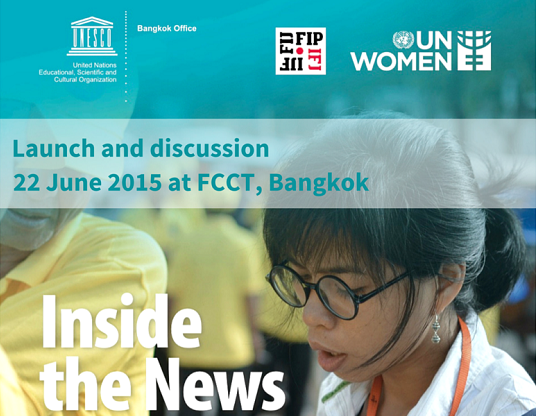
“Inside the News: Challenges and Aspirations of Women Journalists in Asia and the Pacific” to be launched by UNESCO, UN Women and IFJ at Foreign Correspondents’ Club of Thailand in special event on 22 June
BANGKOK, 14 JUNE, 2015 – In many countries across Asia and the Pacific, women media professionals have increased their number in the newsrooms, but they still represent only 3 out of 10 news staff and often earn less than their male counterparts, while struggling to reach decision-making positions.
These are some of the findings in “Inside the News: Challenges and Aspirations of Women Journalists in Asia and the Pacific”, a new study set to be launched by UNESCO, UN Women and the International Federation of Journalists (IFJ) on 22 June. The new study highlights how issues of gender impact the lives and work of journalists in the region, with case studies drawn from the personal accounts of media professionals in Cambodia, India, Malaysia, Nepal, Pakistan, Sri Lanka and Vanuatu.
The launch event will bring together the report’s authors as well as media professionals to assess the situation women journalists in Asia and the Pacific face and strategies that can help foster greater gender equality in the media.
WHAT: Launch of the study: Inside the News – Challenges and Aspirations of Women Journalists in Asia and the Pacific.
WHEN: 22 June 2015, 16:00 – 19:30.
Programme:
16.00-16.30: Registration
16.30-16.45: Opening
16.45-17.15: Presentation of the study’s key findings and recommendations
17.15-18.45: Panel Discussion: “Fostering Gender Equality in the Media – Good Practices from Asia and the Pacific and a Look into the Future”.
18.45-19.30: Closing and reception
WHERE: Foreign Correspondents’ Club of Thailand (FCCT), 518/5, Lumphini, Pathum Wan, Bangkok 10330, access map:http://www.fccthai.com/location.html
WHO:
Opening: Gwang-Jo Kim, UNESCO Bangkok Director, NN, UN Women Regional Office for Asia and the Pacific (Bangkok), Jane Worthington, Deputy Director of IFJ Asia-Pacific (Sydney).
Presentation of key findings and recommendations: Misako Ito, Adviser in Communication and Information, UNESCO Bangkok and Jane Worthington, Deputy Director of the IFJ (Sydney).
Discussion: Dilrukshi Handunnetti, Senior Associate Editor of the Sunday Observer (Colombo), Sujata Madhok, President of the Dehli Union of Journalists (New Dehli), Anothai Udomsilp, Director of Thai PBS (Bangkok) and moderated by Laxmi Murthy, Consulting Editor for Himal Southasian magazine (Kathmandu).
CONTACT: For
 further information about the study or to request an advance copy, and to RSVP (by 18 June, as spaces are limited), please contact: Chantal Mairesse, Communication & Information Unit, UNESCO Bangkok, c.mairesse@unesco.org
Highlights from the study and programme of the launch are attached. Recommendations from the study will be available in English and the languages of the focus countries on 21 June here.
The joint IFJ-UNESCO-UN Women study was published with the support of the Swedish International Development Cooperation Agency (Sida).
Discuss the study “Inside the News” on social media using the hashtag #InsidetheNews
Download the programme of the launch
here.
12 August 2014
Apply to the United States Institute of Peace for JR Peace Scholarship Dissertation Program
July 14, 2014 By Gamala Luitel
Deadline: 12 December 2014
The United States Institute of Peace (USIP) is accepting applications for the Jennings Randolph (JR) Peace Scholarship Dissertation Program. Focused on topics like ‘how to manage conflict and build sustainable peace effectively, the Institute supports advanced research from top academics in variety of fields that contribute to wider understanding.
Total 4-7 candidates will be selected to become the Peace Scholar Fellows. The fellowship period is 10 months starting from September 2015. The fellows will receive $20,000 for 10 months period.
The Peace Scholars will work at their universities or other sites appropriate to their research under the fellowship program. They will work will full attention and submit periodic reports to the Institute. They may also get opportunity to give presentation at the institute and participate in Institute workshops, conferences, and other activities.
Eligibility Criteria
Applicant must provide full contact information of three referees. These referees must be notified earlier by sending a copy of the application and instructions for Referees. Also notify the referees in telephonic conversation that they should receive an email which might have gone to their spam folder. The referees might send the letters via email if they are not able to submit electronically via online system.
For more information, please visit How to apply for JR Peace Scholarship Dissertation Program.
Deadline: 12 December 2014
The United States Institute of Peace (USIP) is accepting applications for the Jennings Randolph (JR) Peace Scholarship Dissertation Program. Focused on topics like ‘how to manage conflict and build sustainable peace effectively, the Institute supports advanced research from top academics in variety of fields that contribute to wider understanding.
Total 4-7 candidates will be selected to become the Peace Scholar Fellows. The fellowship period is 10 months starting from September 2015. The fellows will receive $20,000 for 10 months period.
The Peace Scholars will work at their universities or other sites appropriate to their research under the fellowship program. They will work will full attention and submit periodic reports to the Institute. They may also get opportunity to give presentation at the institute and participate in Institute workshops, conferences, and other activities.
Eligibility Criteria
- Applicants can be the citizens of any country and dissertation projects in all disciplines are welcome.
- Applicants must be enrolled in recognized doctoral programs (for example, Ph.D., S.J.D., Ed.D., Th.D.) in accredited universities in the United States.
- Selected candidates will be eligible for the fellowship only if they complete all course work and examinations towards their doctoral degree at the time their fellowship begins.
- Individuals currently receiving any other major fellowship or award (except in special circumstances and with the written approval of the Institute) will not be considered for fellowship.
- Proposals must include a review of the relevant literature or practice on the subject and should make clear how the questions you are researching are similar to or different from those addressed in the existing literature or in current practice.
Applicant must provide full contact information of three referees. These referees must be notified earlier by sending a copy of the application and instructions for Referees. Also notify the referees in telephonic conversation that they should receive an email which might have gone to their spam folder. The referees might send the letters via email if they are not able to submit electronically via online system.
For more information, please visit How to apply for JR Peace Scholarship Dissertation Program.
UN hosts journalism contest
Journalists worldwide who cover the U.N., including its agencies and field operations, are eligible for awards.
http://ijnet.org/opportunities/un-hosts-journalism-contest-worldwide
The United Nations Correspondents Association (UNCA) is accepting written and electronic works for a U.N. coverage contest that consists of four categories: print and online, broadcast, climate change and humanitarian/development.
The prizes amount to over US$50,000 that will be distributed among the winners.
U.N. Secretary-General Ban Ki-moon will present the prizes at the awards ceremony on Dec. 16 in New York.
Entries can be submitted in any of the official U.N. languages (English, French, Arabic, Chinese, Spanish and Russian). Entries in other languages must be accompanied by a translation in English or French.
The contest deadline is Sept. 15.
For more information, click here.
The United Nations Correspondents Association (UNCA) is accepting written and electronic works for a U.N. coverage contest that consists of four categories: print and online, broadcast, climate change and humanitarian/development.
The prizes amount to over US$50,000 that will be distributed among the winners.
U.N. Secretary-General Ban Ki-moon will present the prizes at the awards ceremony on Dec. 16 in New York.
Entries can be submitted in any of the official U.N. languages (English, French, Arabic, Chinese, Spanish and Russian). Entries in other languages must be accompanied by a translation in English or French.
The contest deadline is Sept. 15.
For more information, click here.
Reagan-Fascell democracy fellowship
Journalists worldwide who wish to learn more about democracy can apply for a fellowship.
http://ijnet.org/opportunities/reagan-fascell-democracy-fellowship-open-worldwide
The Reagan-Fascell Democracy Fellows Program, organized by the National Endowment for Democracy (NED), aims to enable democratic practitioners, scholars and journalists to deepen their understanding of democracy and enhance their ability to promote democratic change.
Each fellow receives a monthly stipend for living expenses, plus health insurance and reimbursement for travel to and from Washington, at the beginning and end of the fellowship period.
Fellows are expected to be in residence at the International Forum for Democratic Studies from March 1 to July 31, 2016. As such, working knowledge of English is required to be eligible.
The deadline to apply is Oct. 15.
For more information, click here and here.
The Reagan-Fascell Democracy Fellows Program, organized by the National Endowment for Democracy (NED), aims to enable democratic practitioners, scholars and journalists to deepen their understanding of democracy and enhance their ability to promote democratic change.
Each fellow receives a monthly stipend for living expenses, plus health insurance and reimbursement for travel to and from Washington, at the beginning and end of the fellowship period.
Fellows are expected to be in residence at the International Forum for Democratic Studies from March 1 to July 31, 2016. As such, working knowledge of English is required to be eligible.
The deadline to apply is Oct. 15.
For more information, click here and here.
Nieman Foundation offers journalism research fellowships
http://ijnet.org/opportunities/nieman-foundation-visiting-fellowships-offered-worldwide
Publishers, programmers, web designers, media analysts, academics and journalists can apply.
The Nieman Foundation for Journalism at Harvard offers short-term, visiting fellowships for research projects designed to advance journalism. These projects can include topics like programming, design, financial strategies and more.
The fellowships can last from a few weeks to three months, depending on the scope of the projects. Fellows will have access to the resources at Harvard, including its scholars, research centers and libraries.
Fellows’ employers are encouraged to extend salary and benefits during the period of study. If they do not, a standard Nieman stipend will be provided. The Nieman Foundation will also help candidates find temporary housing.
The deadline to apply is Aug. 29.
For more information, click here.
The Nieman Foundation for Journalism at Harvard offers short-term, visiting fellowships for research projects designed to advance journalism. These projects can include topics like programming, design, financial strategies and more.
The fellowships can last from a few weeks to three months, depending on the scope of the projects. Fellows will have access to the resources at Harvard, including its scholars, research centers and libraries.
Fellows’ employers are encouraged to extend salary and benefits during the period of study. If they do not, a standard Nieman stipend will be provided. The Nieman Foundation will also help candidates find temporary housing.
The deadline to apply is Aug. 29.
For more information, click here.
Subscribe to:
Posts (Atom)