Pages

10 March 2016

SAWM calls for gender equality

Committed to fair gender portrayal within and outside the media, South Asian Women in Media (SAWM) Sri Lanka, mark International Women’s Day  2016 with a call for journalists to stand up for gender equality and make fair gender portrayal a professional and ethical aspiration, similar to respect for accuracy, fairness and honesty.

One of the greatest challenges we face as journalists, is to resist the culture of casual stereotype in our everyday work. There are fixed images, deeply entrenched prejudices and biased reflexes that pose challenges to journalists and the media. If we are to truly ‘Step It Up for Gender Equality’ as the Day has been themed by the UN, we have to confront these biases and prejudices in our newsrooms, and promote gender equality, both within the working environment and in the representation of women.

There is an urgent need for a discourse to highlight the issue of fair gender portrayal in the news agenda, and SAWM will, as part of its International Women’s Day activities, initiate this discourse by taking a critical look  at how the media tackles the issue of Sri Lankan’s migrant labour. 

The issue is of great significance as 49 % of the 1.8 million Sri Lankans, or 1/10th of the population, who work international migrant workers are women, the majority of them unskilled. Yet, there is no reportage through a feminist or gender lens.

Women journalists themselves have covered women migrants in an event-based manner, despite their economic contribution. There has been no discussion on the recently introduced protectionist policies that restrict women from their right to migrant and have a livelihood. The portrayal of these women has been among the worst, shown as weak, poor, victimised and vulnerable.

SAWM will in the coming weeks hold a workshop to orient a select number of women journalists, working in all three languages, on reporting on this vital issue, breaking the current stereotypes, looking through the gender lens at policy and practice and at the women who line the Sri Lankan economy.


15 June 2015

How can we get more women in newsrooms? New study on gender and journalism in Asia-Pacific gives media professionals their say


MEDIA ADVISORY: How can we get more women in newsrooms? New study on gender and journalism in Asia-Pacific gives media professionals their say


Tagged in:

Asia Pacific, ASIA PACIFIC, Campaigns, Reports, Events, Meeting, Workshop, Conference, Bulletins, Blog


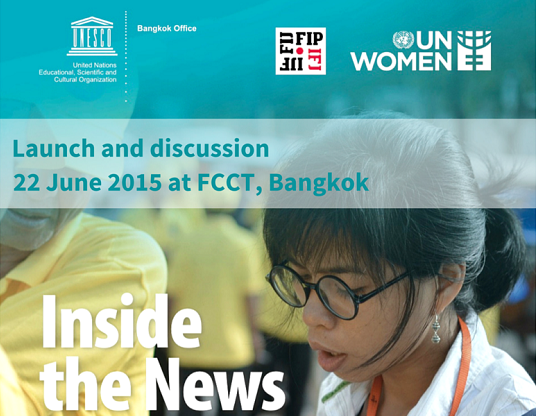
“Inside the News: Challenges and Aspirations of Women Journalists in Asia and the Pacific” to be launched by UNESCO, UN Women and IFJ at Foreign Correspondents’ Club of Thailand in special event on 22 June


BANGKOK, 14 JUNE, 2015 – In many countries across Asia and the Pacific, women media professionals have increased their number in the newsrooms, but they still represent only 3 out of 10 news staff and often earn less than their male counterparts, while struggling to reach decision-making positions.


These are some of the findings in “Inside the News: Challenges and Aspirations of Women Journalists in Asia and the Pacific”, a new study set to be launched by UNESCO, UN Women and the International Federation of Journalists (IFJ) on 22 June. The new study highlights how issues of gender impact the lives and work of journalists in the region, with case studies drawn from the personal accounts of media professionals in Cambodia, India, Malaysia, Nepal, Pakistan, Sri Lanka and Vanuatu.


The launch event will bring together the report’s authors as well as media professionals to assess the situation women journalists in Asia and the Pacific face and strategies that can help foster greater gender equality in the media.


WHAT: Launch of the study: Inside the News – Challenges and Aspirations of Women Journalists in Asia and the Pacific.


WHEN: 22 June 2015, 16:00 – 19:30.


Programme:


16.00-16.30: Registration
16.30-16.45: Opening
16.45-17.15: Presentation of the study’s key findings and recommendations
17.15-18.45: Panel Discussion: “Fostering Gender Equality in the Media – Good Practices from Asia and the Pacific and a Look into the Future”.
18.45-19.30: Closing and reception


WHERE: Foreign Correspondents’ Club of Thailand (FCCT), 518/5, Lumphini, Pathum Wan, Bangkok 10330, access map:http://www.fccthai.com/location.html


WHO:


Opening: Gwang-Jo Kim, UNESCO Bangkok Director, NN, UN Women Regional Office for Asia and the Pacific (Bangkok), Jane Worthington, Deputy Director of IFJ Asia-Pacific (Sydney).


Presentation of key findings and recommendations: Misako Ito, Adviser in Communication and Information, UNESCO Bangkok and Jane Worthington, Deputy Director of the IFJ (Sydney).


Discussion: Dilrukshi Handunnetti, Senior Associate Editor of the Sunday Observer (Colombo), Sujata Madhok, President of the Dehli Union of Journalists (New Dehli), Anothai Udomsilp, Director of Thai PBS (Bangkok) and moderated by Laxmi Murthy, Consulting Editor for Himal Southasian magazine (Kathmandu).


CONTACT: For further information about the study or to request an advance copy, and to RSVP (by 18 June, as spaces are limited), please contact: Chantal Mairesse, Communication & Information Unit, UNESCO Bangkok, c.mairesse@unesco.org


Highlights from the study and programme of the launch are attached. Recommendations from the study will be available in English and the languages of the focus countries on 21 June here.


The joint IFJ-UNESCO-UN Women study was published with the support of the Swedish International Development Cooperation Agency (Sida).


Discuss the study “Inside the News” on social media using the hashtag #InsidetheNews


Download the programme of the launch here.

12 August 2014

Apply to the United States Institute of Peace for JR Peace Scholarship Dissertation Program

July 14, 2014 By Gamala Luitel

Deadline: 12 December 2014

The United States Institute of Peace (USIP) is accepting applications for the Jennings Randolph (JR) Peace Scholarship Dissertation Program. Focused on topics like ‘how to manage conflict and build sustainable peace effectively, the Institute supports advanced research from top academics in variety of fields that contribute to wider understanding.

Total 4-7 candidates will be selected to become the Peace Scholar Fellows. The fellowship period is 10 months starting from September 2015. The fellows will receive $20,000 for 10 months period.

The Peace Scholars will work at their universities or other sites appropriate to their research under the fellowship program. They will work will full attention and submit periodic reports to the Institute. They may also get opportunity to give presentation at the institute and participate in Institute workshops, conferences, and other activities.

Eligibility Criteria
  • Applicants can be the citizens of any country and dissertation projects in all disciplines are welcome.
  • Applicants must be enrolled in recognized doctoral programs (for example, Ph.D., S.J.D., Ed.D., Th.D.) in accredited universities in the United States.
  • Selected candidates will be eligible for the fellowship only if they complete all course work and examinations towards their doctoral degree at the time their fellowship begins.
  • Individuals currently receiving any other major fellowship or award (except in special circumstances and with the written approval of the Institute) will not be considered for fellowship.
  • Proposals must include a review of the relevant literature or practice on the subject and should make clear how the questions you are researching are similar to or different from those addressed in the existing literature or in current practice.

Applicant must provide full contact information of three referees. These referees must be notified earlier by sending a copy of the application and instructions for Referees. Also notify the referees in telephonic conversation that they should receive an email which might have gone to their spam folder. The referees might send the letters via email if they are not able to submit electronically via online system.

For more information, please visit How to apply for JR Peace Scholarship Dissertation Program.

UN hosts journalism contest

Journalists worldwide who cover the U.N., including its agencies and field operations, are eligible for awards.

http://ijnet.org/opportunities/un-hosts-journalism-contest-worldwide

The United Nations Correspondents Association (UNCA) is accepting written and electronic works for a U.N. coverage contest that consists of four categories: print and online, broadcast, climate change and humanitarian/development.

The prizes amount to over US$50,000 that will be distributed among the winners.

U.N. Secretary-General Ban Ki-moon will present the prizes at the awards ceremony on Dec. 16 in New York.

Entries can be submitted in any of the official U.N. languages (English, French, Arabic, Chinese, Spanish and Russian). Entries in other languages must be accompanied by a translation in English or French.

The contest deadline is Sept. 15.

For more information, click here.

Reagan-Fascell democracy fellowship

Journalists worldwide who wish to learn more about democracy can apply for a fellowship.

http://ijnet.org/opportunities/reagan-fascell-democracy-fellowship-open-worldwide

The Reagan-Fascell Democracy Fellows Program, organized by the National Endowment for Democracy (NED), aims to enable democratic practitioners, scholars and journalists to deepen their understanding of democracy and enhance their ability to promote democratic change.

Each fellow receives a monthly stipend for living expenses, plus health insurance and reimbursement for travel to and from Washington, at the beginning and end of the fellowship period.

Fellows are expected to be in residence at the International Forum for Democratic Studies from March 1 to July 31, 2016. As such, working knowledge of English is required to be eligible.

The deadline to apply is Oct. 15.

For more information, click here and here.

Nieman Foundation offers journalism research fellowships

http://ijnet.org/opportunities/nieman-foundation-visiting-fellowships-offered-worldwide

Publishers, programmers, web designers, media analysts, academics and journalists can apply.

The Nieman Foundation for Journalism at Harvard offers short-term, visiting fellowships for research projects designed to advance journalism. These projects can include topics like programming, design, financial strategies and more.

The fellowships can last from a few weeks to three months, depending on the scope of the projects. Fellows will have access to the resources at Harvard, including its scholars, research centers and libraries.

Fellows’ employers are encouraged to extend salary and benefits during the period of study. If they do not, a standard Nieman stipend will be provided. The Nieman Foundation will also help candidates find temporary housing.

The deadline to apply is Aug. 29.

For more information, click here.

01 July 2014

Science journalism fellowship

http://ijnet.org/opportunities/science-journalism-fellowship-open-worldwide-0

Experienced reporters, writers, editors, producers, or program hosts interested in exploring complex systems more deeply can apply for this fellowship.

The Santa Fe Institute (SFI) is offering a residential fellowship in Santa Fe, New Mexico, for accomplished reporters with a demonstrated interest in and record of reporting about matters related to complex systems.

The fellowship term is at least one month and up to three months, which provides an immersive opportunity for fellows to participate in SFI complexity education programs, and to participate in scientific workshops, working groups, offsite meetings such as Business Network Topical Meetings and SFI Short Courses.

A monthly stipend of US$7,000 is provided; this amount includes the cost of housing. Travel reimbursement of up to US$2,000 is provided so the fellow may participate in one or more SFI-sponsored offsite events.

Journalists from all countries can compete, with priority given to journalists working primarily in the English language.

Applicants must submit their resume, five past examples of work, a fellowship proposal letter and two letters of recommendation.

The application deadline is Aug. 1.

For more information, click here.

23 June 2014

The Society of Environmental Journalists Fund for Journalists around the globe

June 19, 2014 By Gamala Luitel


Deadline: 15 July 2014

The Society of Environmental Journalists (SEJ) invites environmental journalists around the world to apply for grants. The SEJ’s Environmental Journalism Fund helps the journalists underwrite environmental reporting projects and entrepreneurial ventures. The primary objective of the fund is to provide incentives and support to qualified journalists and news organizations to enhance the quantity and quality of environmental journalism.

The SEJ provides up to $3,500 for the research work which can be spent towards project-related travel, training, research materials, database analysis, environmental testing, and other direct non-personnel costs required for success of the reporting project or entrepreneurial venture.

Eligibility Criteria
  • Applicants must be qualified journalist working independently or on the staff of either a for-profit or non-profit news organization worldwide.
  • Applicants’ work must be in journalism or closely related to journalism, and her/his responsibilities must not include public relations work on environmental issues or lobbying on environmental issues.
  • Applicants can be either the SEJ member or may be non-members.
  • Journalists working for print, broadcast and/or online media; and full-time faculty or students working or enrolled at accredited schools are the eligible applicants who, also, are eligible to become the SEJ member.

For more information, please visit Fund for Environmental Journalism.

20 June 2014

SAFMA Sri Lanka appeals for balanced news media coverage

Condemns attacks on journalists

SAFMA Sri Lanka appeals for balanced news media coverage 

The South Asian Free Media Association, with national chapters in all SAARC countries, is a grouping of journalists with a social commitment to devote their profession towards full democracy and development. On the basis of our concern for our own Sri Lankan society we have noted the relatively low coverage of the recent social-religious clashes and the on-going tension in the country among our various communities.  

As veteran media professionals, we are aware that most media houses had sent reporting teams to the riot-hit areas very early as the violence began to escalate. The new expressway enabled quick deployment of media teams to the affected area thereby ensuring coverage of incidents from an early stage of the unrest. Despite the availability of the information gathered by the media personnel, there has been a stark paucity of news coverage of what is the single most significant and newsworthy situation in the country today.

We find that there is a public perception, both locally and internationally, that the Sri Lankan news media are under-reporting the current anti-Muslim social unrest. There are also reports of informal pressure applied by the Government on media managements not to report the violent incidents in Aluthgma and Beruvala areas. This under-reporting of actual violent events and causal incidents, contributes to the spread of untruthful and biased information through means of social media networks and public rumours.

SAFMA Sri Lanka has received complaints of physical harassment and intimidation of journalists in the field covering the incidents and condemns these attacks. It is possible that informal political pressures as well as the general atmosphere of long-time political intimidation of the media have contributed to the low-key publication and broadcast of reports on this communal unrest. The journalistic community both here and internationally, has a long and proud tradition of bravely resisting pressures and daring to report every socially important incident, especially situations of injustice. We should not be deterred by these pressures.   

SAFMA Sri Lanka thus calls on all Sri Lankan journalists and media houses to fulfil their patriotic duty and responsibility by observing the highest standards of socially responsible and non-sensationalist reporting of the current situation of communal tensions. The Sri Lankan news media is challenged to ensure accurate and balanced coverage of events and incidents relating to the current social clashes and thereby help create better public awareness of actual issues which, in turn, will counter the rumours and deliberate allegations by unpatriotic elements to provoke suspicion and hostility between socio-religious communities.

SAFMA-SL extends it fullest co-operation in all efforts by the Ministry of Mass Media and also by relevant civil society groups to manage a comprehensive flow of information to the public in a manner that would ensure maximum awareness and minimum mis-perception and provocation among the general public.


--//--

Bastiat Prize for Journalism

The 13th annual Bastiat Prize for Journalism will award $16,000 in prizes to writers from around the globe who explain the importance of freedom with originality, wit, and eloquence.


Winner: $10,000
Second Prize: $5,000
Third Prize: $1,000.

For complete rules, entry form and past winning entries, go to:
http://reason.com/reasonmediaawards/bastiatprizeforjournalism.php


Eligibility: Work first published in print and/or online between July 1, 2013 and June 30, 2014, including but not limited to articles in newspapers, magazines, and blogs.

Deadline: Entries must be received by July 31, 2014

Frédéric Bastiat (1801-1850) was a French philosopher and politician whose clear, elegant writing used simple illustrative examples persuasively to make the case that "The solution to the problems of human relationships is to be found in liberty."

In the enduring spirit of Bastiat's brilliant work and his profound understanding and explication of the dangers of government intervention, the Bastiat Prize for Journalism is given to writers who explain the importance of freedom with originality, wit, and eloquence.

The winner of the Bastiat Prize will be announced at the Reason Media Awards dinner in New York City on November 10, 2014.

The Bastiat Prize is one of three prizes which will be awarded in the 2014 Reason Media Awards, which showcase the efforts of outstanding journalists who are advancing the principles of free minds and free markets by educating their readers about individual liberty, free markets, and the rule of law. For more information, visit: www.reasonmediaawards.org