Pages

20 January 2025


STATEMENT    

Headline :    Victor Ivan an icon of socially committed journalism

                                                          – SAFMA Sri Lanka

Victor Ivan is a Sri Lankan icon of social activism and journalism. The Sri Lanka Chapter of the South Asian Free Media Association (SAFMA-SL) expresses its deep sadness at his passing. Mr. Ivan traversed a civic, professional and intellectual personal life journey taken by many world intellectuals, prominent or less known throughout the history of civilization.  

His youthful life in courageous militant activism in the rural social rebellion of 1971, was notable for the political leadership he gave to that rebellion. He physically suffered in the 1971 struggle and also in the consequent legal punishments.

Mr. Ivan was then inspired to move quickly into the realm of civic activism along the same track of championing social justice, and then took up professional journalism of the highest calibre in the tradition of other socially-committed journalists in many societies going through social crises. His contributions as a public intellectual has been second to none and parallels his accomplishments in the Sinhala professional journalistic and literary fields. A distinguished aesthete, he has contributed much to setting standards in modern Sinhala journalism.

--//--        


24 July 2022

Halt attacks on journalists, ensure Freedom of Expression for citizens

Halt attacks on journalists, ensure Freedom of

Expression for citizens

– SAFMA Sri Lanka


The Sri Lanka Chapter of the South Asian Free Media Association (SAFMA) strongly condemns the deliberate violence against peaceful protestors near the President’s Office and the physical assault and dispersal of journalists covering the incidents by members of the security forces.

The attacks on the political protestors on Galle Face Green, Colombo, and their forcible dispersal is a blatant, brutal suppression of the protesting citizens’ freedom of expression. The attacks on the journalists reporting these incidents is equally condemned as a shocking violation of professional media rights as well as the suppression of the right of citizens to information.    

In the interests of sustainable social peace and stability, SAFMA Sri Lanka calls on the Government to respect the will of the country’s citizens who have demonstrated peacefully and successfully, these past four months, their unified, consensual, call for a complete change of regime. Without such stability, the much-needed economic recovery is delayed, further burdening the people with more suffering.

We call on the world community to express solidarity with the struggle for democracy and survival of society in Sri Lanka.

21 June 2022

Sir Harry Evans Global Fellowship

Sir Harry Evans Global Fellowship

The Fellowship provides an unrivalled opportunity for an exceptional early career journalist: a six to nine month Fellowship with Durham University which will include undertaking an investigative project from inside the Reuters newsroom in London, mentored by top Reuters editors in the field while being overseen by Durham University and having access to University academics and research resources. This Fellowship is designed to give the applicant the chance to develop rigorous, fact-based research and reporting skills.   

The Fellowship was created in honour of Sir Harry Evans, one of the pioneers of modern investigative journalism. The award winning work he spearheaded as editor of The Northern Echo, The Sunday Times and The Times - from his celebrated campaign to obtain compensation for Thalidomide children, to exposing the cover-up of Soviet spy Kim Philby and unmasking corporate deception at the heart of the DC-10 Paris air crash in 1974 - made him the gold standard of courageous public interest journalism. He was voted by his media peers as the Greatest British Newspaper Editor of all time. 

How to apply 

Applications for the Fellowship close midday BST Monday 15 August 2022 and are to be submitted by email.   

1. Complete the Sir Harry Evans Global Fellowship Application form (.docx). Within this form, you will be asked to complete:  

  •  A short statement (up to 500 words) telling the Fellowship Committee about yourself; what you hope to achieve with this opportunity; and how your vision of journalism fits with the spirit of the Fellowship.    
  • A detailed proposal (up to 800 words) for an investigative project you would like to execute during the Fellowship. Multimedia journalism is encouraged, and the proposal can include a small amount of relevant visual material, such as graphics, photos or a video clip. The proposal should tell the Fellowship Committee clearly what the story is about; what’s original about it, including what the new findings would be; why the story is important; what impact it might have; how you would report it; and how you would tell it. This proposal will be an important part of the Fellowship Committee’s evaluation, though Reuters editors may opt to assign the successful fellow another project.

2. Save your completed form in the file format: FirstName-Surname-SHEF-Fellowship.

3. In addition to the application form, we also require the following:   

  • Demonstration of published examples of work (up to five examples), as links to published work or as attachments to the email.
  • A letter of recommendation from an editor who has worked closely with you, assessing your abilities and potential as an investigative journalist.  

4. Send the completed form and attachments to SHEF@durham.ac.uk no later than midday BST Monday 15 August 2022. 

Selection process  

The Harry Evans Fellowship is a global opportunity, and we therefore welcome applications from all eligible candidates, regardless of their current location. The Fellowship will be undertaken in Durham and London, and the successful candidate will need to meet applicable immigration requirements. We encourage applications from members of groups who are under-represented in the media. 

The application process will be overseen by the Fellowship Committee who will ensure a diverse panel of candidates are considered for the opportunity. Applicants will be assessed in accordance with the selection criteria above. The final stage will be an interview.  

The successful applicant will be notified of the outcome by Saturday 1 October 2022. The Fellowship will commence in early 2023.

What the Fellowship offers

The Sir Harry Evans Global Fellowship in Investigative Journalism provides the opportunity for an early career journalist to develop their ideas and collaborations in a thriving community of journalists and researchers, including through engagement with the University’s departments, institutes and colleges.  

The successful applicant will be employed by Durham University for the period of the Fellowship and will spend time on placement in the Reuters newsroom in London, or with another suitable partner selected by Reuters. The successful applicant will also be allocated an appropriate academic supervisor and mentor at Durham University.  

The Fellowship commands a monthly salary of c.£4,444 per month for each month of the Fellowship (equivalent to a pro-rata salary of c.£53,333 per year), in addition to a maximum £1,250 per month living stipend, and a one-off payment of £1,800 for travel and expenses. 

Where the successful applicant is an existing employee of a news or media organisation and taking a period of leave in order to pursue the Fellowship, Durham University will pay up to a maximum of £12,000 to their employer to cover temporary staff costs, subject to specific terms and conditions.

Fellowship selection criteria

Qualified applicants will be early in their careers and will have professional journalism experience. 

Where a prospective applicant is not currently a journalist but has worked in an investigative reporting capacity in a related professional field (for example: leading human rights or other socio-political publications and campaigns; working as an author or researcher on authoritative investigative work; or developing in-field photo- or video-research projects, documentaries, or exhibitions) applications may be considered on case-by-case basis. 

Applicants should apply as per the instructions and format outlined above. 

Closing date

The closing date for applications to the Sir Harry Evans Global Fellowship in Investigative Journalism for 2022 is midday BST Monday 15 August 2022.

Application, inclusive of the completed application form and relevant attachments, must be emailed to SHEF@durham.ac.uk no later than this date/time.

Should applicants wish to discuss any questions, these can be submitted to SHEF@durham.ac.uk for response.

Sir Harry Evans in conversation with reporters

The Fellowship Committee will, from time to time, review selection requirements and, if appropriate, discuss and agree on updated requirements in order to continue to meet the objectives of the Fellowship. Updates will be published on this website.

For more information on how Durham University collects and processes your data please see our Privacy Notice.

18 May 2021

18 May 2021

Call for immediate ceasefire    

Attack on media offices in Gaza is war crime – SAFMA Sri Lanka


The Sri Lanka Chapter of the South Asian Free Media Association (SAFMA) expresses its shock and revulsion at the deliberate targeting and destruction of offices of news media in the Gaza Strip by Israeli military units. SAFMA Sri Lanka, which comprises socially concerned professional journalists, unreservedly condemns this attack on an important civilian information service facility at a time of war when public information has extra importance in ensuring human safety.    

SAFMA notes that the Al-Jalaa building in central Gaza that was destroyed on Saturday housed both civilian residents as well as the Gaza branch offices of the US-based Associated Press (AP) and Qatar-based Al Jazeera.   The fact that the Israeli military authorities warned the building owners and also the news agencies concerned of the impending attack, ostensibly in order to save lives, clearly indicates that this attack on a civilian structure was a deliberate military action. In destroying this vital public informational facility, the Israeli military thereby denies the Gaza population the prompt public information system that is most needed for human safety in a time of war. Thus, the ostensible attempt to save lives in the course of the attack is negated several fold by the consequent denial of life-saving public information services during the on-going military operations.

As a body of professional journalists who have reported on counter-insurgency operations and the war in Sri Lanka, SAFMA sees this military action by the Israeli armed forces as a War Crime and, calls on the world community, especially the United Nations, to swiftly investigate this incident and bring the perpetrators to justice. 

SAFMA also calls on the world community to enforce prevailing United Nations Resolutions and other mechanisms to ensure the complete halt to illegal Israeli settlement expansion activities that have been the principal provocations of unrest among the Palestinian population. The arbitrary, forcible, eviction of Palestinian residents and displacement from home sites has been a pattern of oppression repeated over seven decades of Israel’s military occupation of the Palestinian homeland. It is perpetrated by the government in Tel Aviv in total violation of general international laws of human rights, rules governing military occupations and, also violates the numerous United Nations Resolutions expressly prohibiting the settling of Israelis on lands belonging to Palestinians or otherwise used by the indigenous Palestinian population. 

13 May 2019

Message from Lakshman Gunaseekara, President - Sri Lanka Chapter of SAFMA

My personal thoughts are with Sri Lanka's Islamic community (of all denominations) as they observe the month of Ramazan in conditions of social siege and state security operations following the Easter bombings. And this social pressure is on them despite their post bombing cooperation with the authorities to a degree that is historic in our long history of counter insurgencies. Never before has a large Sri Lankan social constituency so quickly and so collectively shunned and exposed an insurgent movement emerging from it (because this group is not a genuine expression of community interests). Already Sri Lanka's Islamic community and Muslim society is turning out to be the most rationally responding community in terms of reacting to such a dangerous phenomenon. I wish all followers of Islam a secure and stable Ramazan.

Lakshman Gunaseekara
President - Sri Lanka Chapter of SAFMA

11 July 2018

SAFMA Exco meets

Just after the Executive Committee meeting of South Asian Free Media Association (SAFMA) Sri Lanka Chapter held on July 10, 2018 at SLPI Board Room. In picture:- Lakshman Gunasekara, Thaha Muzammil, Sharmini Boyle, NM Ameen, Hana Ibrahim, Shan Wijetunga and Dilrukshi Handunnetty. Pix by S.L. Azeez


05 July 2018

SAFMA-SL condemns targeting of Lankan journalists


The Sri Lanka chapter of the South Asian Free Media Association is very concerned about the targeting by politicians of two Sri Lankan journalists involved in internationally reporting on Sri Lankan issues published recently in the New York Times newspaper of the USA. We are concerned that, due to this individual targeting, the professional sights of these journalists have been violated. We are also concerned that the targeting is being done by senior leaders of a political group that, when it was last in governmental power, presided over a regime that saw the collective intimidation and repression of the news media industry of by extreme violence.

Singling out and publicly targeting individual professionals for the work they perform for an employer, in this case, an internationally published newspaper, is only valid if those individuals at least appeared to have seriously violated the country’s laws in any manner. In the case of the detailed news report published by the ‘New York Times’ newspaper of the USA, headlined ‘How China got Sri Lanka to cough up a port’ on June 25, 2018, the two Sri Lankan journalists concerned were the local support reporters for the American journalist team belonging to the ‘New York Times’.

As an organisation of socially concerned journalists, SAFMA-SL upholds the right of anyone to respond to any news publication in terms of public criticism of the published item or even its publisher. In terms of the law as well as professional practice, both locally and internationally, the responsibility for publication of any news product is held by the publisher and not the employee professionals concerned.

Individual professionals are singly targeted for investigation only if there is a violation of law by the publisher that is formally considered by the authorities as serious enough to investigate and prosecute all the personnel seen as complicit. In the case of the said news report, so far, no legal authorities, either Sri Lankan or American, have thought fit to raise issues of wrong-doing, certainly not of an urgent nature that has immediate social repercussions.

The public naming of these two journalists last week remarkably echoed that period of repression and the behaviour of politicians that heralded such massive rights violations and violence. The fact that this political criticism has sparked off a wave of similar or even worse criticism of these two individual professionals via internet social media is indicative of an attempt to intimidate Sri Lanka’s news professional community as a whole.

05 April 2018

News 1st attack harms media freedom


Statement by South Asian Free Media Association – Sri Lanka Chapter 

The South Asian Free Media Association Sri Lanka Chapter condemns the attack on the Head Office  of Sirasa News First in Colombo on Wednesday April 4th night as an alarming and shameful attack on the news media freedom in the country.

We are reliably informed that an unruly mob exploded large amounts of fire crackers outside the gates of the News First head office complex in Colombo and threw exploding fireworks at the closed gates and boundary walls of the news group premises. Given past experience of even more destructive attacks including firing of weapons by armed men, the staff of News 1st were reportedly severely traumatised by the Wednesday night incident which clearly directly targeted their news organisation. 

SAFMA-Sri Lanka considers such attacks, from whatever quarter, to be an act of intimidation and terrorising of people, in this case a news media organisation. It is a violation of the right of freedom of expression at a time when the nation had presumed that such freedoms had been restored after a decade of violent political repression.

SAFMA demands that the law and order authorities immediately investigate this incident and prosecute the perpetrators. Only quick and firm remedial action will convince the public that democratic freedoms have genuinely been restored in this country. 

18 March 2018

Let industry self-regulate social media


Statement by South Asian Free Media Association – Sri Lanka Chapter 

Let industry self-regulate social media      
                                                                             -- SAFMA Sri Lanka

The Sri Lanka Chapter of the South Asian Free Media Association welcomes moves to curb abuse of internet social media but warns that State interference may only open new ways to suppress freedom of expression. We say: let the industry self-regulate social media.

SAFMA Sri Lanka is alarmed at the continued use of internet social media networks to spread ethnic hatred. The recent anti-Muslim violence in the country was accompanied by the rampant use of such social media sites as Face Book, What’s App and Instagram to spread anti-Muslim suspicions and hatred. Social media are similarly used to spread hatred and suspicion of other ethnic groups as well. Internet social media are also used to spread false information to mislead and incite the public to commit acts of violence against targeted social groups. 

This racist propaganda often espouses social attitudes of ethnic dominance and elite ethnic privilege that subvert the nation’s assurance of equality and justice to all its citizens.

The continued use of social media sites to spread ethnic hatred, supremacist attitudes and, incite communal violence urgently requires redress in the form of regulation of such internet sites to prevent future such socially destabilisation communication usage. SAFMA-SL supports action for such regulation and calls on the internet industry and web professionals to take responsibility for such regulation, with government facilitation.

SAFMA Sri Lanka points out the poor record of governments in attempting to control communication content by means of sustained censorship of content either through Emergency powers or through such mechanisms as the Censor Board and Press Council. These powers and mechanisms have been flagrantly and repeatedly abused by successive regimes in the past to suppress dissent and illegitimately sustain their tenure in power. 

While welcoming current moves to swiftly introduce regulation of social media content, SAFMA Sri Lanka insists that the government should only perform a facilitating role in enabling the stakeholders of the internet industry, both service providers and content producers, in establishing mechanisms of industry self-regulation. 

While the regulating cyber architecture may require support by the Telecommunications Regulatory Commission, we urge that the oversight body for the regulatory mechanisms provides for adequate industry and professional representation to ensure that this architecture is not manipulated by government or other political interests.

SAFMA Sri Lanka reminds the government and the general public of the continued burning need for all such controls over freedom of expression to be placed under a publicly appointed body that is autonomous of government control. 
--//--  


10 March 2016

SAWM calls for gender equality

Committed to fair gender portrayal within and outside the media, South Asian Women in Media (SAWM) Sri Lanka, mark International Women’s Day  2016 with a call for journalists to stand up for gender equality and make fair gender portrayal a professional and ethical aspiration, similar to respect for accuracy, fairness and honesty.

One of the greatest challenges we face as journalists, is to resist the culture of casual stereotype in our everyday work. There are fixed images, deeply entrenched prejudices and biased reflexes that pose challenges to journalists and the media. If we are to truly ‘Step It Up for Gender Equality’ as the Day has been themed by the UN, we have to confront these biases and prejudices in our newsrooms, and promote gender equality, both within the working environment and in the representation of women.

There is an urgent need for a discourse to highlight the issue of fair gender portrayal in the news agenda, and SAWM will, as part of its International Women’s Day activities, initiate this discourse by taking a critical look  at how the media tackles the issue of Sri Lankan’s migrant labour. 

The issue is of great significance as 49 % of the 1.8 million Sri Lankans, or 1/10th of the population, who work international migrant workers are women, the majority of them unskilled. Yet, there is no reportage through a feminist or gender lens.

Women journalists themselves have covered women migrants in an event-based manner, despite their economic contribution. There has been no discussion on the recently introduced protectionist policies that restrict women from their right to migrant and have a livelihood. The portrayal of these women has been among the worst, shown as weak, poor, victimised and vulnerable.

SAWM will in the coming weeks hold a workshop to orient a select number of women journalists, working in all three languages, on reporting on this vital issue, breaking the current stereotypes, looking through the gender lens at policy and practice and at the women who line the Sri Lankan economy.


15 June 2015

How can we get more women in newsrooms? New study on gender and journalism in Asia-Pacific gives media professionals their say


MEDIA ADVISORY: How can we get more women in newsrooms? New study on gender and journalism in Asia-Pacific gives media professionals their say


Tagged in:

Asia Pacific, ASIA PACIFIC, Campaigns, Reports, Events, Meeting, Workshop, Conference, Bulletins, Blog


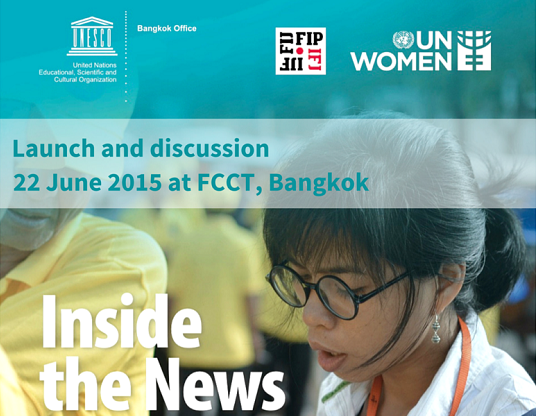
“Inside the News: Challenges and Aspirations of Women Journalists in Asia and the Pacific” to be launched by UNESCO, UN Women and IFJ at Foreign Correspondents’ Club of Thailand in special event on 22 June


BANGKOK, 14 JUNE, 2015 – In many countries across Asia and the Pacific, women media professionals have increased their number in the newsrooms, but they still represent only 3 out of 10 news staff and often earn less than their male counterparts, while struggling to reach decision-making positions.


These are some of the findings in “Inside the News: Challenges and Aspirations of Women Journalists in Asia and the Pacific”, a new study set to be launched by UNESCO, UN Women and the International Federation of Journalists (IFJ) on 22 June. The new study highlights how issues of gender impact the lives and work of journalists in the region, with case studies drawn from the personal accounts of media professionals in Cambodia, India, Malaysia, Nepal, Pakistan, Sri Lanka and Vanuatu.


The launch event will bring together the report’s authors as well as media professionals to assess the situation women journalists in Asia and the Pacific face and strategies that can help foster greater gender equality in the media.


WHAT: Launch of the study: Inside the News – Challenges and Aspirations of Women Journalists in Asia and the Pacific.


WHEN: 22 June 2015, 16:00 – 19:30.


Programme:


16.00-16.30: Registration
16.30-16.45: Opening
16.45-17.15: Presentation of the study’s key findings and recommendations
17.15-18.45: Panel Discussion: “Fostering Gender Equality in the Media – Good Practices from Asia and the Pacific and a Look into the Future”.
18.45-19.30: Closing and reception


WHERE: Foreign Correspondents’ Club of Thailand (FCCT), 518/5, Lumphini, Pathum Wan, Bangkok 10330, access map:http://www.fccthai.com/location.html


WHO:


Opening: Gwang-Jo Kim, UNESCO Bangkok Director, NN, UN Women Regional Office for Asia and the Pacific (Bangkok), Jane Worthington, Deputy Director of IFJ Asia-Pacific (Sydney).


Presentation of key findings and recommendations: Misako Ito, Adviser in Communication and Information, UNESCO Bangkok and Jane Worthington, Deputy Director of the IFJ (Sydney).


Discussion: Dilrukshi Handunnetti, Senior Associate Editor of the Sunday Observer (Colombo), Sujata Madhok, President of the Dehli Union of Journalists (New Dehli), Anothai Udomsilp, Director of Thai PBS (Bangkok) and moderated by Laxmi Murthy, Consulting Editor for Himal Southasian magazine (Kathmandu).


CONTACT: For further information about the study or to request an advance copy, and to RSVP (by 18 June, as spaces are limited), please contact: Chantal Mairesse, Communication & Information Unit, UNESCO Bangkok, c.mairesse@unesco.org


Highlights from the study and programme of the launch are attached. Recommendations from the study will be available in English and the languages of the focus countries on 21 June here.


The joint IFJ-UNESCO-UN Women study was published with the support of the Swedish International Development Cooperation Agency (Sida).


Discuss the study “Inside the News” on social media using the hashtag #InsidetheNews


Download the programme of the launch here.

12 August 2014

Apply to the United States Institute of Peace for JR Peace Scholarship Dissertation Program

July 14, 2014 By Gamala Luitel

Deadline: 12 December 2014

The United States Institute of Peace (USIP) is accepting applications for the Jennings Randolph (JR) Peace Scholarship Dissertation Program. Focused on topics like ‘how to manage conflict and build sustainable peace effectively, the Institute supports advanced research from top academics in variety of fields that contribute to wider understanding.

Total 4-7 candidates will be selected to become the Peace Scholar Fellows. The fellowship period is 10 months starting from September 2015. The fellows will receive $20,000 for 10 months period.

The Peace Scholars will work at their universities or other sites appropriate to their research under the fellowship program. They will work will full attention and submit periodic reports to the Institute. They may also get opportunity to give presentation at the institute and participate in Institute workshops, conferences, and other activities.

Eligibility Criteria
  • Applicants can be the citizens of any country and dissertation projects in all disciplines are welcome.
  • Applicants must be enrolled in recognized doctoral programs (for example, Ph.D., S.J.D., Ed.D., Th.D.) in accredited universities in the United States.
  • Selected candidates will be eligible for the fellowship only if they complete all course work and examinations towards their doctoral degree at the time their fellowship begins.
  • Individuals currently receiving any other major fellowship or award (except in special circumstances and with the written approval of the Institute) will not be considered for fellowship.
  • Proposals must include a review of the relevant literature or practice on the subject and should make clear how the questions you are researching are similar to or different from those addressed in the existing literature or in current practice.

Applicant must provide full contact information of three referees. These referees must be notified earlier by sending a copy of the application and instructions for Referees. Also notify the referees in telephonic conversation that they should receive an email which might have gone to their spam folder. The referees might send the letters via email if they are not able to submit electronically via online system.

For more information, please visit How to apply for JR Peace Scholarship Dissertation Program.

UN hosts journalism contest

Journalists worldwide who cover the U.N., including its agencies and field operations, are eligible for awards.

http://ijnet.org/opportunities/un-hosts-journalism-contest-worldwide

The United Nations Correspondents Association (UNCA) is accepting written and electronic works for a U.N. coverage contest that consists of four categories: print and online, broadcast, climate change and humanitarian/development.

The prizes amount to over US$50,000 that will be distributed among the winners.

U.N. Secretary-General Ban Ki-moon will present the prizes at the awards ceremony on Dec. 16 in New York.

Entries can be submitted in any of the official U.N. languages (English, French, Arabic, Chinese, Spanish and Russian). Entries in other languages must be accompanied by a translation in English or French.

The contest deadline is Sept. 15.

For more information, click here.

Reagan-Fascell democracy fellowship

Journalists worldwide who wish to learn more about democracy can apply for a fellowship.

http://ijnet.org/opportunities/reagan-fascell-democracy-fellowship-open-worldwide

The Reagan-Fascell Democracy Fellows Program, organized by the National Endowment for Democracy (NED), aims to enable democratic practitioners, scholars and journalists to deepen their understanding of democracy and enhance their ability to promote democratic change.

Each fellow receives a monthly stipend for living expenses, plus health insurance and reimbursement for travel to and from Washington, at the beginning and end of the fellowship period.

Fellows are expected to be in residence at the International Forum for Democratic Studies from March 1 to July 31, 2016. As such, working knowledge of English is required to be eligible.

The deadline to apply is Oct. 15.

For more information, click here and here.

Nieman Foundation offers journalism research fellowships

http://ijnet.org/opportunities/nieman-foundation-visiting-fellowships-offered-worldwide

Publishers, programmers, web designers, media analysts, academics and journalists can apply.

The Nieman Foundation for Journalism at Harvard offers short-term, visiting fellowships for research projects designed to advance journalism. These projects can include topics like programming, design, financial strategies and more.

The fellowships can last from a few weeks to three months, depending on the scope of the projects. Fellows will have access to the resources at Harvard, including its scholars, research centers and libraries.

Fellows’ employers are encouraged to extend salary and benefits during the period of study. If they do not, a standard Nieman stipend will be provided. The Nieman Foundation will also help candidates find temporary housing.

The deadline to apply is Aug. 29.

For more information, click here.

01 July 2014

Science journalism fellowship

http://ijnet.org/opportunities/science-journalism-fellowship-open-worldwide-0

Experienced reporters, writers, editors, producers, or program hosts interested in exploring complex systems more deeply can apply for this fellowship.

The Santa Fe Institute (SFI) is offering a residential fellowship in Santa Fe, New Mexico, for accomplished reporters with a demonstrated interest in and record of reporting about matters related to complex systems.

The fellowship term is at least one month and up to three months, which provides an immersive opportunity for fellows to participate in SFI complexity education programs, and to participate in scientific workshops, working groups, offsite meetings such as Business Network Topical Meetings and SFI Short Courses.

A monthly stipend of US$7,000 is provided; this amount includes the cost of housing. Travel reimbursement of up to US$2,000 is provided so the fellow may participate in one or more SFI-sponsored offsite events.

Journalists from all countries can compete, with priority given to journalists working primarily in the English language.

Applicants must submit their resume, five past examples of work, a fellowship proposal letter and two letters of recommendation.

The application deadline is Aug. 1.

For more information, click here.

23 June 2014

The Society of Environmental Journalists Fund for Journalists around the globe

June 19, 2014 By Gamala Luitel


Deadline: 15 July 2014

The Society of Environmental Journalists (SEJ) invites environmental journalists around the world to apply for grants. The SEJ’s Environmental Journalism Fund helps the journalists underwrite environmental reporting projects and entrepreneurial ventures. The primary objective of the fund is to provide incentives and support to qualified journalists and news organizations to enhance the quantity and quality of environmental journalism.

The SEJ provides up to $3,500 for the research work which can be spent towards project-related travel, training, research materials, database analysis, environmental testing, and other direct non-personnel costs required for success of the reporting project or entrepreneurial venture.

Eligibility Criteria
  • Applicants must be qualified journalist working independently or on the staff of either a for-profit or non-profit news organization worldwide.
  • Applicants’ work must be in journalism or closely related to journalism, and her/his responsibilities must not include public relations work on environmental issues or lobbying on environmental issues.
  • Applicants can be either the SEJ member or may be non-members.
  • Journalists working for print, broadcast and/or online media; and full-time faculty or students working or enrolled at accredited schools are the eligible applicants who, also, are eligible to become the SEJ member.

For more information, please visit Fund for Environmental Journalism.

20 June 2014

SAFMA Sri Lanka appeals for balanced news media coverage

Condemns attacks on journalists

SAFMA Sri Lanka appeals for balanced news media coverage 

The South Asian Free Media Association, with national chapters in all SAARC countries, is a grouping of journalists with a social commitment to devote their profession towards full democracy and development. On the basis of our concern for our own Sri Lankan society we have noted the relatively low coverage of the recent social-religious clashes and the on-going tension in the country among our various communities.  

As veteran media professionals, we are aware that most media houses had sent reporting teams to the riot-hit areas very early as the violence began to escalate. The new expressway enabled quick deployment of media teams to the affected area thereby ensuring coverage of incidents from an early stage of the unrest. Despite the availability of the information gathered by the media personnel, there has been a stark paucity of news coverage of what is the single most significant and newsworthy situation in the country today.

We find that there is a public perception, both locally and internationally, that the Sri Lankan news media are under-reporting the current anti-Muslim social unrest. There are also reports of informal pressure applied by the Government on media managements not to report the violent incidents in Aluthgma and Beruvala areas. This under-reporting of actual violent events and causal incidents, contributes to the spread of untruthful and biased information through means of social media networks and public rumours.

SAFMA Sri Lanka has received complaints of physical harassment and intimidation of journalists in the field covering the incidents and condemns these attacks. It is possible that informal political pressures as well as the general atmosphere of long-time political intimidation of the media have contributed to the low-key publication and broadcast of reports on this communal unrest. The journalistic community both here and internationally, has a long and proud tradition of bravely resisting pressures and daring to report every socially important incident, especially situations of injustice. We should not be deterred by these pressures.   

SAFMA Sri Lanka thus calls on all Sri Lankan journalists and media houses to fulfil their patriotic duty and responsibility by observing the highest standards of socially responsible and non-sensationalist reporting of the current situation of communal tensions. The Sri Lankan news media is challenged to ensure accurate and balanced coverage of events and incidents relating to the current social clashes and thereby help create better public awareness of actual issues which, in turn, will counter the rumours and deliberate allegations by unpatriotic elements to provoke suspicion and hostility between socio-religious communities.

SAFMA-SL extends it fullest co-operation in all efforts by the Ministry of Mass Media and also by relevant civil society groups to manage a comprehensive flow of information to the public in a manner that would ensure maximum awareness and minimum mis-perception and provocation among the general public.


--//--

Bastiat Prize for Journalism

The 13th annual Bastiat Prize for Journalism will award $16,000 in prizes to writers from around the globe who explain the importance of freedom with originality, wit, and eloquence.


Winner: $10,000
Second Prize: $5,000
Third Prize: $1,000.

For complete rules, entry form and past winning entries, go to:
http://reason.com/reasonmediaawards/bastiatprizeforjournalism.php


Eligibility: Work first published in print and/or online between July 1, 2013 and June 30, 2014, including but not limited to articles in newspapers, magazines, and blogs.

Deadline: Entries must be received by July 31, 2014

Frédéric Bastiat (1801-1850) was a French philosopher and politician whose clear, elegant writing used simple illustrative examples persuasively to make the case that "The solution to the problems of human relationships is to be found in liberty."

In the enduring spirit of Bastiat's brilliant work and his profound understanding and explication of the dangers of government intervention, the Bastiat Prize for Journalism is given to writers who explain the importance of freedom with originality, wit, and eloquence.

The winner of the Bastiat Prize will be announced at the Reason Media Awards dinner in New York City on November 10, 2014.

The Bastiat Prize is one of three prizes which will be awarded in the 2014 Reason Media Awards, which showcase the efforts of outstanding journalists who are advancing the principles of free minds and free markets by educating their readers about individual liberty, free markets, and the rule of law. For more information, visit: www.reasonmediaawards.org

21 May 2014

One Month Long Feminist Capacity Building Course by Sangat South Asia

April 29, 2014 By Gamala Luitel


Deadline: 30 June 2014

Women professionals and researchers in South Asia Region working as trainers/facilitators of capacity building processes/programs on gender, peace, development, rights are invited to participate in one month long Feminist Capacity Building Course on Gender, Sustainable Livelihoods, Human Rights and Peace. The training program organized by Sangat – a South Asian Feminist Network is to be held from 14 September to 14 October 2014 in TEWA Center, Kathmandu, Nepal.

This is the 19th series of Sangat Course designed as ‘Training for Trainers’ and thus focus on training methodology, presentations by participants, training materials and others related topics. Women who have already attended the course are highly encouraged to participate. Maximum 40 women professionals will be participating in the training course.

The training course is designed to provide clarity, dialogue and shared understanding on concepts and issues related to gender, justice, poverty, sustainable development, peace, democracy and human rights.

Eligibility Criteria:
Applicants can be the trainers/facilitators of capacity building processes/programs on gender, peace, development, human rights.
Applicants must have a minimum of five years’ work experience and some experience as trainers or facilitators.
Applicants must have good working knowledge of spoken and written English.
Applicants must have a background working on women’s empowerment, human rights, agriculture, sustainable livelihoods, labour, holistic health, peace, democracy, secularism and other related fields.
Applicant must hold a passport with at least one year validity before applying.

Application materials include completed application form, personal information sheet, curriculum vitae of applicant/nominee, a write up (800-1000 words), and fellowship application.

For more information, please visit Apply for South Asian Month Long Course.